

Writing is a phenomenal experience; it’s even more so once you’ve published. But before that, protecting your ideas and manuscript is a top priority. You need to learn how to handle your files, use technology, filter out people with ill intentions, make backups, and more. Then you need to learn how to protect yourself online, keep your privacy safe, and keep your social media secure.
Please note: I will update this post as I learn new methods. If you have information you would like me to include, please contact me here.
The latest update: 16th/03/2026
Accidents:
Becoming a good file manager is necessary to safeguard your manuscript from accidental deletions, errors, hardware malfunctions, viruses, hackers, etc. Make sure you have several backups of your work in safe places just in case your computer crashes. You can have a:
- physical backup by printing everything
- a semi-physical one, such as a mini-encrypted hard-drive
- or a digital backup, like the Cloud
- Cloud services are great, but make sure they are secure
- A good idea is to encrypt all your digital files with passwords
Your digital files are important because the metadata – this is the date, timestamp, and other information on the file — is an indicator that you wrote your stories at the time and date you claim.
There was an old-fashioned way of protecting your manuscript, but I’m not sure if anyone is practicing it any more:
- Print out your entire manuscript
- Seal it in a large envelope/package
- Mail it to yourself
- Once received, DO NOT OPEN IT
- Keep the envelope/package somewhere safe
- The stamp shows the day it was mailed
- Just remember, once the envelope/package is opened, you cannot put the manuscript back in and seal it. The seal serves as proof, like a time capsule, if you ever need to make a claim.
- Only open it in the presence of witnesses
There are paid-for services online which will secure your manuscript in their database. Please check reviews from customers before using these companies. Copyright offices, such as the U.S. Copyright Office, will copyright your manuscript. You can retrieve your work whenever you need to make a claim.
Plagiarists – Digital Sharing:
The basic steps to keep yourself safe are never share your work with anyone you do not fully trust. Years ago, Stephenie Meyer, author of The Twilight Series, gave an unfinished manuscript to a friend to read. Unfortunately, that friend shared and leaked her manuscript online. Mistakes happen, so I can’t stress just how important this is: always protect your work before you share anything.
Plagiarists – Verbal Sharing:
Be careful who you share your ideas with verbally. When I was an undergraduate, a friend and I used to discuss our ideas together. Long story short, they took my research and ideas and wrote a poem about them. They got a lot of praise for those ideas, and I had no way of proving that those ideas were mine.
Something similar happened to a friend of mine. They shared their ideas verbally with a friend during a writing course they both attended. Their friend wrote two short novels on those ideas and published them quickly. In the end, my friend had no way of proving that those characters and plotlines were originally theirs.
Just because you trust them does not mean all friends or colleagues are honourable. Please be careful who you share your work with. The best thing to do is to write your ideas first, protect them, then partially share them when you are absolutely certain this person will not betray you.
Scammers:
A scammer by the name of Filippo Bernardini, impersonated agents and publishers to steal over 1,000 manuscripts, including work from famous authors. The best practice is to research any agent or publisher you contact. See who they have worked with and published; watch out for scam-y email addresses and sites.
As the co-ordinator of the Singapore Writer’s Group, I sometimes get emails from scammers. As mentioned earlier, there are scammers posing as agents, publishers, and now editors. They contact writing groups or aspiring writers with social media accounts to sweet-talk writers into hiring them. Sometimes they just steal the work, and other times they provide mediocre and unprofessional editing services from fake companies.
Have a look at the screenshot below. I have removed the name and email of the scammer just in case I am wrong:
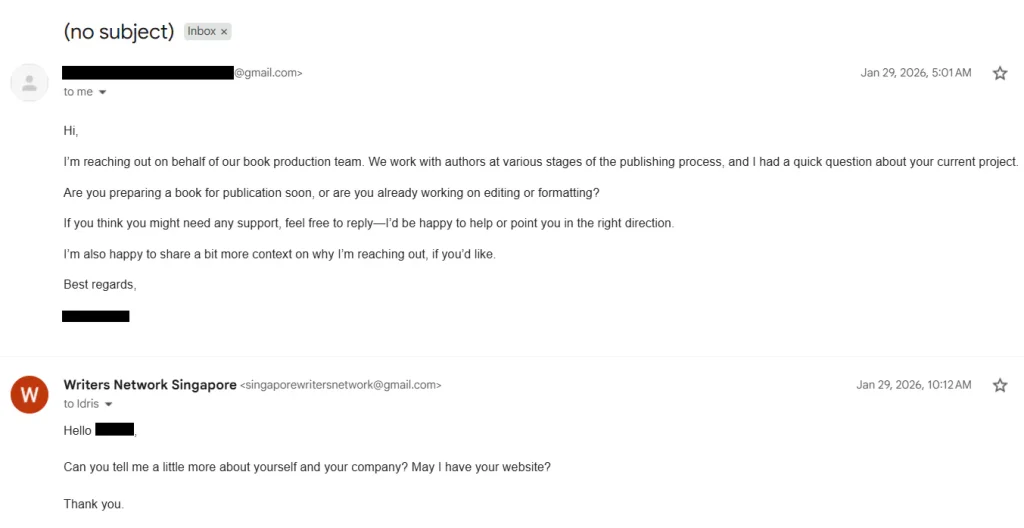
Here are the reasons I think this is a scammer:
- The email contained the scammer’s name along with numbers and letters. It was also a gmail.com account, which signals that this is not a professional company.
- There is no title for the email.
- The scammer talks about their company while making no reference to the company’s name or their own position.
- They make presumptions about the SWN, which means they don’t really know who we are or what we do.
- The scammer leaves no other forms of communication, such as websites, profile pages, company emails, or phone numbers.
- A known tactic of scammers is to send vague messages to as many people as possible and see who would be gullible enough to answer.
- Yes, I answered, but I have a reason:
- Last year, we had another scammer contact us with a website. I am compiling a list of websites, names, and information on the scammers to share with the SWN members so they are aware of who is targeting us.
- Followup: The scammer tried to email me a couple more times. He continuously refused to share any information on his ‘company.’
So first things first, you need to filter out the fakes from the genuine agents and publishers. Here are some questions and checks you can do:
- Start by checking their emails:
- Look at their email links to see if they are from a company.
- Does the name after @ belong to them, or is it a generic one from some other emailing service?
- Is the name before the @ theirs or a variety of numbers and letters?
- Email content:
- Check if their emails have spelling and grammar mistakes.
- If this is a professional, they should not have obvious mistakes in their emails.
- Check if they have a website:
- Is it professionally made, or a quick, made-up one from a basic web provider? For example, I can quickly open a WordPress account and build a website within an hour.
- Check the link name of the website. Is it their name or their company’s name?
- Point of contact:
- Is the person you are emailing the same person represented on the website?
- I once had a scammer email me as a freelance editor. He told me his name. When I checked his website, there was an AI-generated image of a woman, with a woman’s name and credentials listed on the site.
- Ask questions:
- I asked several scammers if they could tell me what education they had. One stopped emailing, and another listed a random college and degree a few days later. I checked the college and searched through the degrees. The college had no such course or degree.
- Ask for their credentials.
- Previous projects:
- Ask the scammers for other books they published and worked on.
- Try to contact those authors to ask about the agent.
Once you catch them in their lies, it makes it easier to tell who is the scammer and who is genuine.
Vanity Publishers:
Vanity publishers are not necessarily scammers, but their work ethic is not that honest, and here is why: I had a friend of mine self-publish through one of these companies. The company promised to edit, proofread, and format the book professionally, as well as provide a cover design. The proofreading missed some mistakes, and the book cover was awful. My friend published the book, but they ended up making their own cover. After that, my friend was left with no marketing help.
Such publishers are often called Vanity Publishers. Their product is not the book; their product is the writer. The vanity publisher does not care if your book is a success or not; they just want you to buy their publishing packages. In contrast, traditional publishers have a reputation to maintain. They benefit from book sales because they share a percentage of the sales, so they heavily invest in your success.
For a quick review, here is a breakdown of the different publishers:
- Traditional Publishers:
- Their goal is to publish the best books and continuously make a profit for you and themselves.
- Will not ask you to pay.
- Will ask you to work with their editing, proofreading, etc. in-house team.
- Are heavily invested in your success because this will mean more sales for them.
- The author will have a percentage of the profits.
- Will do most of the work, but that means less power for you.
- Hybrid Publishers
- Their goal is to publish great books, but they need help with the initial finances.
- Will ask you to pay for certain services.
- Might have their own in-house team, but you have the option of finding your own editors, proofreaders, designers, etc.
- You will need to either pay for marketing or find your own marketing team.
- Vanity Publishers:
- Their goal is to sell you a publishing package.
- They have no interest in your success.
- Their employees are not always professionals in the literary world.
- Will charge you for everything.
- Self Publishers:
- Will provide the platform for you to upload your work, edit, and publish (i.e. Amazon’s Kindle Direct Publishing KDP).
- Will provide technical support.
- May provide marketing platforms (i.e. Amazon Ads).
- Will provide both physical and digital books. Amazon has a print on demand feature, so physical books will only be printed if a customer orders them. There is no ready-made stockpile of printed books.
- Unless you pay someone, you will have to do all the writing, editing, proofreading, formatting, cover design and marketing.
- Minus the fees for using the various platforms, you will keep all the profits.
Pseudo Names:
This technique is not new and has saved many authors from a lot of trouble. Separate your personal life from your writing life by having a pseudonymous writer’s name.
Personal Life:
This might be an impossible ask, but try to scrub as much information about yourself from the internet, such as addresses and places of work. The less about your physical whereabouts on the net, the better.
Author N. K. Jemisin spoke about using a proxy company to buy her house. That way her name and address were not listed publicly. If you become famous, you really don’t want strangers knowing where you live.
Social Networks:
Once you become an author, you become a public figure. As a public figure, you have responsibilities to yourself and your readers.
In this day and age, people need to watch what they say online. Something said years ago could come back to haunt you. And anything you say now will always be used against you, so do not give haters a valid reason to make others turn against you.
If you belong to a minority, there is an added level of responsibility. Because few of your people publish work, you might be the first point of contact for many readers. In both an honorary and uncomfortable way, you become the public figure and representative of your people or group. Anything you say or do will be directly applied to all of your people or group. You become a minor celebrity once you publish a novel. The more success you gain, the bigger your audience.
Look at cases of celebrities who have said or done something socially unacceptable. Yes, they get talked about and often their products sell for more, but nowadays boycotting has become an effective strategy to punish public figures. Do not forget your friends and loved ones who have to manage the fallout in their own lives. For now, you are on your own, but once you make it big, you can hire a team, if your publishers don’t do this for you, to help you handle your public image.
The Authors Guild:
The Authors Guild has a lot of practical and legal advice on how to protect yourself and your work. They also provide a range of advice, from copyright advice, dispute interventions, contract reviews, and you can request specific legal advice.
Homework:
- Take the steps to scrub sensitive information about your whereabouts, addresses, places of work, etc.
- Always back up your manuscripts and ideas before sharing them anywhere.
- Limit verbal sharing to those you absolutely trust and in secure locations.
- Watch yourself on social media.
NEXT:
Please look forward to the next post: 1-7 Plotter – Pantser – Plantser: Which One Are You?
Image by GuHyeok Jeong from Pixabay